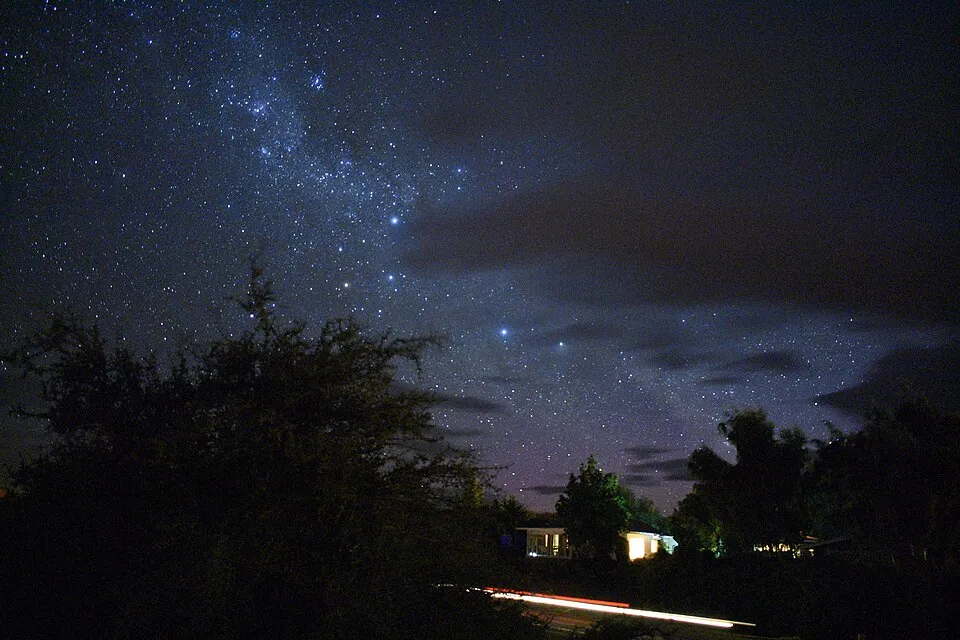
How New Zealand Protects the Night Sky in Aoraki Mackenzie
Key Vocabulary
Unwanted artificial light that brightens the night environment.
Light pollution makes faint stars difficult to see.
A fixed piece of equipment such as a streetlight.
The new fixture directs light toward the pavement.
An area officially protected for the quality of its night sky.
The region attracts visitors because it is a dark-sky reserve.
Travel focused on viewing and learning about the night sky.
Astrotourism creates work for local guides.
To protect something so that it remains in good condition.
Lighting rules help preserve views of the Milky Way.
Article
Modern communities often use brighter streets and buildings as signs of safety and development. In New Zealand's Mackenzie region, however, natural darkness is treated as an environmental resource that requires active protection.
The Aoraki Mackenzie International Dark Sky Reserve includes Aoraki/Mount Cook National Park and much of the Mackenzie Basin in the South Island. DarkSky International explains that outdoor-lighting controls began in the area during the early 1980s, helping protect the nearby Mount John Observatory and the wider night environment. [1]
Light pollution occurs when artificial light is brighter, more widespread or more poorly directed than necessary. It can hide faint stars, waste electricity and disturb the natural cycle between daylight and darkness.
Protecting a dark sky does not require a community to remove every streetlight. Better fixtures direct light toward the ground, limit unnecessary blue-rich light and use only the brightness needed for a particular task. Timers and motion sensors can reduce lighting when an area is empty.
The reserve covers approximately 4,367 square kilometres and includes Lake Tekapo, Lake Pukaki and Aoraki/Mount Cook National Park. The region promotes stargazing as one of its major visitor experiences. [2]
Night-sky tourism creates economic opportunities for guides, hotels, restaurants and transport providers. Visitors can use telescopes, learn about astronomy or simply view the Milky Way in conditions that are difficult to find near large cities.
Tourism can also threaten the resource it depends on. New accommodation, roads and commercial signs may introduce additional light. Communities therefore need standards that allow useful development without gradually weakening the darkness visitors came to experience.
The night sky has cultural as well as scientific importance. Māori knowledge includes detailed observation of stars, seasonal patterns and navigation. Responsible education can connect modern astronomy with Indigenous knowledge of the same sky.
Darkness also matters to wildlife. Artificial light can influence feeding, movement and reproduction in species that depend on natural day-and-night cycles. The reserve sits beside nationally protected landscapes, linking night-sky policy with broader conservation. [3]
The Aoraki Mackenzie model challenges the belief that more lighting is always better. Its approach is not to choose darkness instead of safety, but to use light carefully and only where it provides a clear benefit.
A star-filled sky can disappear slowly, one poorly designed lamp at a time. Preserving it requires residents, businesses and visitors to recognize that darkness is part of the environment rather than an empty space waiting to be illuminated.
Discussion Questions
- How visible are the stars from the place where you live?
- What balance should communities find between nighttime safety and light pollution?
- How could your country develop astrotourism without damaging the places visitors come to see?
- Why might natural darkness deserve protection in the same way as forests or clean water?
- Which unnecessary sources of nighttime light could be reduced in your community?