Can Three Minutes of Radio Exercise Support Healthy Aging?
Key Vocabulary
| Word or Phrase | Meaning | Example |
|---|---|---|
| routine | A set of actions performed regularly | Stretching is part of her morning routine. |
| flexibility | The ability to bend and move easily | Regular movement can help maintain flexibility. |
| balance | The ability to remain steady without falling | This exercise tests your balance. |
| endurance | The ability to continue an activity for a period of time | Walking can improve physical endurance. |
| frailty | Physical weakness that can develop with age | Exercise may help older adults at risk of frailty. |
Article
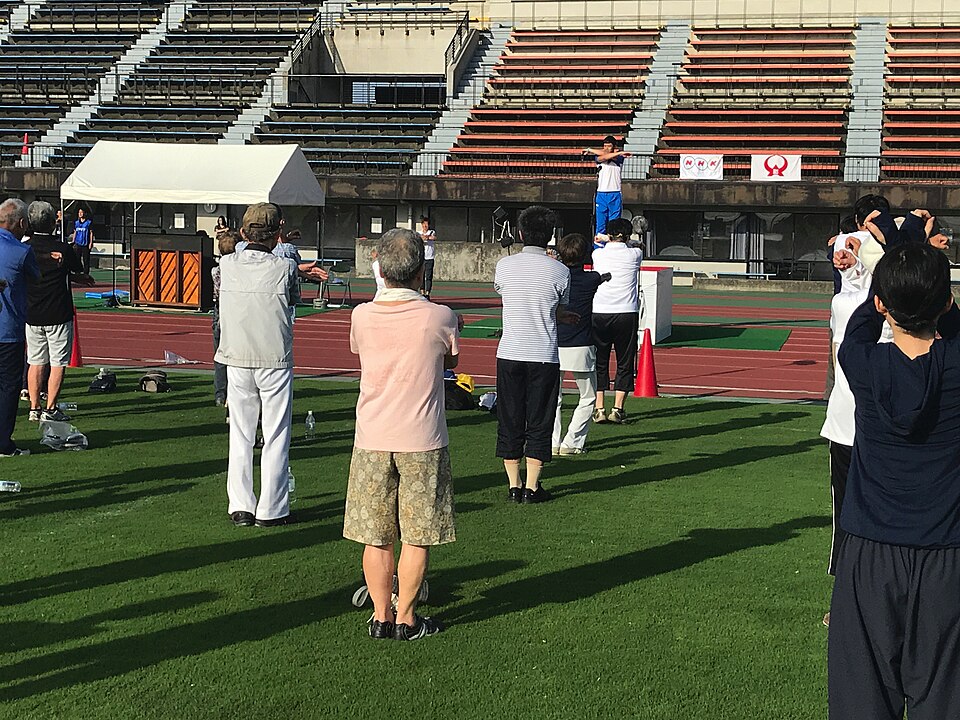
Early in the morning, people gather in parks, workplaces, and community spaces across Japan. Music begins to play, and groups perform a familiar series of bends, stretches, arm movements, and small jumps.
This activity is called Radio-Taiso, or radio calisthenics. The main routine lasts only about three minutes and is designed to be simple enough for people of different ages and fitness levels. Participants can follow it through radio, television, online videos, or a group leader.
Radio-Taiso was first introduced in 1928 by the Postal Life Insurance Bureau, which later became part of Japan Post Insurance. The routine spread nationwide through broadcasts by NHK, Japan’s public broadcaster. Today, Japan Post Insurance, NHK, and the Japan Radio-Taiso Federation continue to promote it through events and school programs.
Its popularity comes partly from its simplicity. The movements do not require special clothing, expensive equipment, or a gym membership. People can do the routine at home, in an office, or outdoors. Because everyone follows the same rhythm, it can also become a shared social activity.
Radio-Taiso is often mentioned in discussions about healthy aging in Japan. However, a short exercise routine alone cannot explain national longevity. Many factors influence lifespan, including healthcare, diet, income, smoking habits, social relationships, genetics, and the environment.
Researchers have studied whether Radio-Taiso can still provide measurable health benefits. A 2024 randomized controlled trial involving 226 older adults at risk of frailty examined a 12-week program that included group instruction and home practice.
The study found improvements in agility, balance, aerobic endurance, and confidence in continuing exercise. However, it did not show a significant improvement in overall health-related quality of life. This suggests that while the routine can support physical function, it is not a complete health solution.
One of the most important strengths of Radio-Taiso may be consistency. A demanding exercise program can produce strong results, but it is less useful if people stop doing it after a short time.
Radio-Taiso shows how a small daily habit can become part of national culture. It also raises a broader question: when improving health, is the best exercise the most intense one, or the one people can continue for years?
Discussion Questions
- Does your country have a traditional or nationally recognized exercise routine?
- Would people in your country feel comfortable exercising together in public spaces?
- Is a three-minute routine useful, or too short to make a difference?
- What habits help older adults stay active in your community?
- Is consistency more important than exercise intensity?